How to Get Your Team to Actually Use AI: 3 Free Fixes
70% of small business owners say their team needs more AI training to get real value. Three free fixes that turn AI access into actual use.
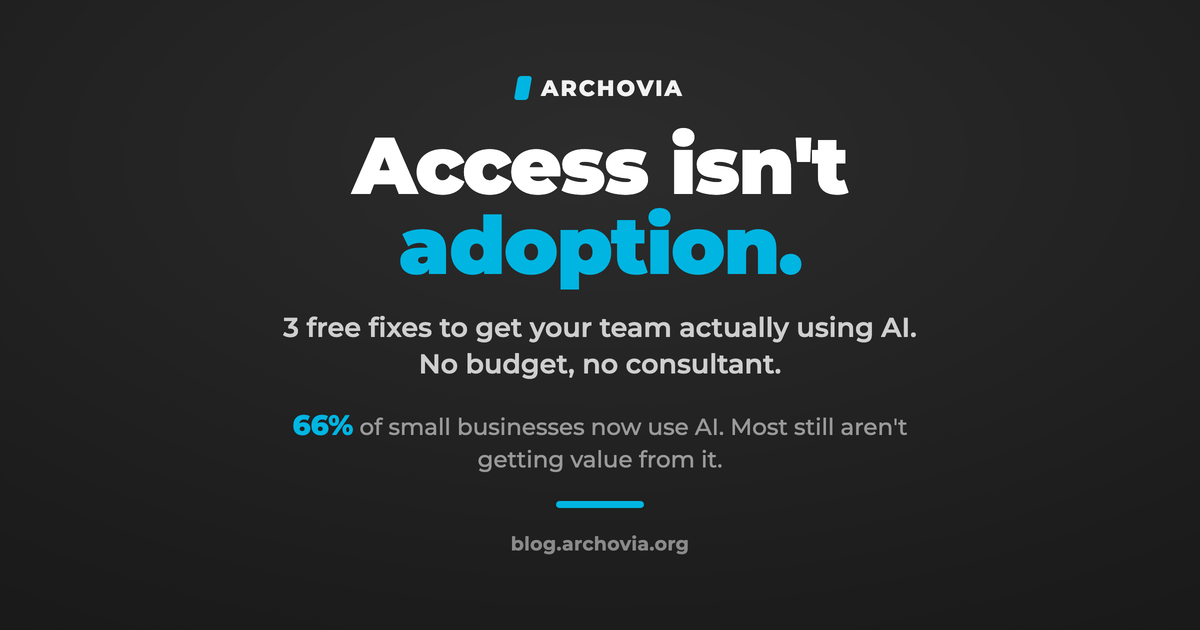
Small business AI adoption just hit 66%, up from 55% a year ago. That is the good headline from a new Goldman Sachs survey of small-business owners. Here is the number underneath it that matters more: 70% of those same owners say their team still needs more training to actually get value out of it.
Translate that into what it looks like on a Tuesday: the company has a ChatGPT or Claude subscription. One or two people use it well. Everyone else opened it once, typed something vague, got a mediocre answer, and never went back. The tool is not the bottleneck. The habit is.
Access is not adoption
It is tempting to read "70% need more training" as a budget problem, something a course or a consultant fixes. It usually is not. Most small teams do not need a training program. They need three small, specific things that turn "we have AI" into "we use AI," and none of them cost money.
Why "use AI more" does not work
If the only instruction your team ever got was "try using AI more," that is not a system, it is a hope. People default to whatever already works, especially under deadline pressure. Vague encouragement loses to an existing habit every time. What beats an old habit is a new one that is specific, shared, and small enough to actually stick.
Three fixes, starting this week
1. Build one shared prompt library
Every person on the team is currently reinventing the wheel alone, in their own chat history, most of it thrown away after one use. Fix that with a single shared document (a Google Doc, a Notion page, anything everyone can reach) where good prompts get pasted the moment someone finds one that works. Label each one with what it is for: "first draft of a donor thank-you," "clean up a rough meeting transcript," "outline a client proposal." The library does not need to be sophisticated. It needs to exist and grow every week.
2. Fifteen minutes, once a week
Put a standing 15-minute slot on the calendar, same time every week, whole team. One question: what did you try with AI this week, and did it work? No prep, no slides. This is the single highest-leverage habit on the list, because it turns private, forgettable experiments into shared, repeatable knowledge. It also surfaces the people quietly getting real value, so their approach can spread instead of staying stuck in one inbox.
3. One owned use case per person
Instead of telling everyone to "use AI more," assign each person exactly one task to own. The person who writes proposals owns the first-draft-of-a-proposal prompt. The person who runs meetings owns turning transcripts into notes. Ownership beats a general mandate, because a specific, named job is something a person can actually get good at and be accountable for. Once that one use case is solid, adding a second one is easy. Starting with ten is how none of them stick.
Pair these three habits with a simple AI-use policy so your team knows the guardrails, not just the tools. Structure is what turns access into adoption.
Start this week, measure in 30 days
Pick a start date for the weekly 15-minute huddle. Create the shared doc and drop in the first three prompts yourself, so the library is not empty on day one. Assign the first owned use case to the person most likely to actually try it, so the early wins are real and visible to the rest of the team.
Then check back in 30 days. Is the library growing on its own? Is the huddle still on the calendar, or did it quietly get skipped twice? Are the owned use cases actually being used? If the answer is yes, you are already ahead of most of that 70%. If not, you learned something cheap and specific to fix, which is a better outcome than another quarter of "we should really use AI more."
What is the one task on your team that would make the best first owned use case?
Sources: Survey: Small Businesses Embrace AI — But Need Training and Support (Goldman Sachs), AI Adoption Continues to Rise, but 70% Say They Need More Training (Yahoo Finance)